Teacher insight from Lindsay, Senior Teacher at ECS Scotland
In my classes at ECS Scotland, adult learners bring different levels of English, professional experience and communication styles. This variety reflects real life: at work and in everyday situations, we communicate with people who express themselves in different ways.
A mixed-level class provides opportunities to practise adjusting your message, checking your understanding and communicating complex ideas clearly.

Natural discussion features strongly in all our small group courses
But sometimes the students ask us, ‘Why is the group mixed level? How does that help me?’
Why mixed levels reflect real communication
Outside the classroom, we cannot choose the English level of every person we meet. A colleague may use specialist vocabulary, while a client may prefer straightforward language. Someone may speak fluently but use an unfamiliar accent or communication style.
Working with different speakers helps you become more flexible. You learn to listen carefully, notice what another person needs and adapt the way you communicate.
These are valuable skills for anyone who works with international colleagues, clients or professional networks.
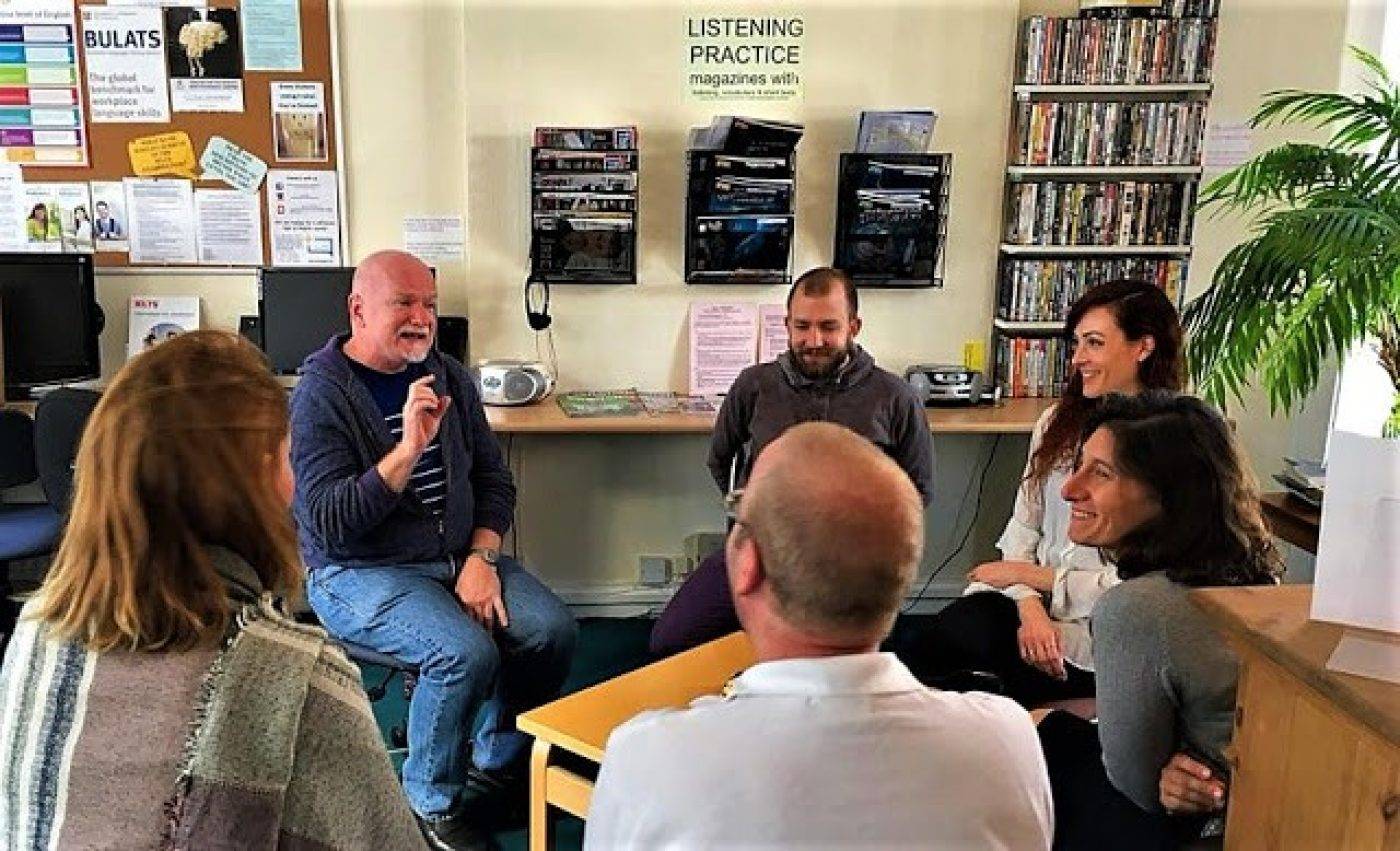

Talking to people with different levels of English is beneficial for everyone
When you are the more confident speaker
If you are more confident using English, or more familiar with the topic, you can practise expressing the same idea in more than one way. This might involve defining a key term, choosing a different example or reorganising your explanation so that the meaning becomes clearer without losing its precision.
You can practise:
• defining a specialist term rather than avoiding it;
• approaching the idea from a different perspective;
• putting the information into a clearer context;
• using an example, comparison or analogy.
Useful phrases include:
• “By ___, I mean…”
• “Another way of looking at it is…”
• “Let me put that into context.”
• “A useful comparison would be…”
• “For example…”
Keep the conversation collaborative and focused on exchanging ideas. Offer an explanation or reframe a point when it is useful, while making space for the other person’s knowledge, experience and perspective.
Being able to communicate a complex idea in several different ways is an advanced language skill. It demonstrates flexibility and precision rather than a lack of progress.
When someone seems more fluent than you
Some people speak quickly or at length, which can make them sound more confident. However, speaking more does not necessarily mean communicating more effectively.
Focus on the key information rather than worrying about every individual word. Listen for the main point and any important details, such as names, numbers, actions or decisions. If something important is unclear, ask a specific question.
Useful phrases include:
• “Have I understood you correctly? Did you say that ___?”
• “Could you rephrase that?”
• “Could you say that in another way?”
• “Could you spell that word, please?”
• “Which part is most important here?”
Repeating the message in your own words is particularly useful because it checks your understanding and gives the other person an opportunity to correct or clarify the information.
Good communication does not depend on understanding every word. It depends on identifying the meaning, asking useful questions and making sure that both people understand each other.
Clarifying a point is part of effective professional communication.
Practise with an AI conversation partner
An AI conversation tool can be a useful practice partner when you are studying independently. If it has a voice function, speak rather than type so that you can practise listening and responding in real time.
Copy this prompt into the tool:
“Be my English conversation partner. Ask me to explain a topic from my work, interests or experience.
If anything is unclear, ask me to explain it in another way or give an example. Then explain an idea to me and let me ask questions to check that I understand.”
Try using phrases from this article in your practice, such as:
• “By ___, I mean…”
• “Have I understood you correctly?”
• “Could you rephrase that?”
Choose a general topic and do not share confidential work information or sensitive personal details.
AI conversation tools can provide convenient, repeatable practice, but their responses and corrections are not always reliable. They cannot replace feedback from a qualified teacher or the experience of communicating with real people.
Lindsay
Senior Teacher


